Thursday

Drag versus Momentum


During my polar journeys my teams have to sustain themselves for weeks on end – my South Pole and beyond journey was 71 days!

Isolated from the outside world we must take all the supplies we need; food, fuel, shelter, emergency equipment, spare clothing and much more. Once we load our sledges up with this mountain of supplies we then have to physically haul our loads.

Too much weight equals less glide for the sledge and we won’t complete our journey before the short polar season ends, or worse still we will move too slow to even reach our objective. Excess weight does not just drain energy, by slowing forward momentum it stifles motivation, eats away at self-belief and limits the ability to grasp opportunities.

How much excess weight are you carrying in your team or organisation?

Explore More

Tuesday

Teambuilding Tactics from Winning Polar Teams

TMS Development International Ltd have just released a Case Study on my leadership of the Polar Quest expeditions and how I used the Team Management Profile to create and sustain high performance. Here are some extracts...

Building an effective team

Regardless of each individual's skills, experience and character, to succeed, it was essential that we were committed to working together as a team. To do this we needed to understand and appreciate the value of each member's team role.

Taking the team forward

A key issue on the Arctic expedition was that the preferences of the inexperienced team seemed to come out more strongly as the journey unfolded, leading to tensions.

Better team outcomes

In Antarctica, the record-breaking team accomplished their goal as the first and longest unsupported services expedition to make the overland journey - 2,590 kms in 71 days.

Towards the end, the team had learnt to value each other's preferences and we all shared the leadership. After I injured my shoulder, my fellow team members took it in turns to look after the logistics of the kiting and route planning – although the Controller-Inspector was by far the best navigator!

Teamwork strategies

I believe that employee empowerment, and a teambuilding approach, enables people to make better decisions. Using the Team Management Profile, I will be able to build this into my expedition strategies.

Leadership at all levels

Through real experiences on these increasingly demanding journeys, I have realised that peak performance develops when the function of leadership exists throughout the team. The ability to know when to lead and when to follow, and generating the levels of trust within the team that allow leadership to shift from one person to another, are crucial ingredients for developing high performance.

Sean’s top 5 teambuilding tactics

1. Respect individual perspectives by sharing Profiles within the team
Before each expedition, I gave each team member an A4 photo sheet, with contact details and their team mates' major and related role Wheel 'segments'. This was a real prompt for effective communication. When contacting a Controller-Inspector, I would remember his preference for more detailed background and send an email. Likewise, I would give a Thruster-Organiser a brief summary, or a phone call.

2. Move from working groups to teams
Build ‘Tent-Time’ discussions into your project. Once our chores were done, we took 20 minutes to review progress and look ahead at our strategy and progress towards the next goal. This open and honest discussion ensured that everyone felt comfortable raising leadership or team issues. Any successful team should always ask, 'How can we improve?'

3. Avoid role gaps by compensating for missing team roles
The Margerison-McCann Types of Work Model is a useful project planning tool to ensure all work areas are covered. We set a 'green' or Reporter-Advisor agenda item so that we would cover our main role gap. After a while, it became natural to gather more information before making decisions.

4. Pace team members throughout the challenge
For the South Pole, I created a pacing profile for each team member, listing their likes and dislikes. I gave each of them a copy of these notes to look at after they had completed their daily journals. This was a useful mental reminder for the following day of how to communicate most effectively.

5. Use the Team Management Systems approach every day
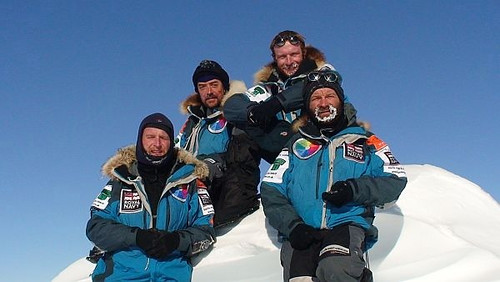
Our jackets had the Team Management Wheel sewn onto them, so we had a constant visual reminder of the importance of good communication during our journey.

To read the full Case Study visit TMSDI

Part 1 : Polar Teamwork & Success

Sean features on the world's foremost explorers website ExplorersWeb where he shares his insights into teamwork and success.

Read the complete article by Correne Coetzer at ExplorersWeb

Wednesday

10 Golden Rules for Polar Explorers

These rules were written by a team of successful polar explorers.

1. Go for both poles
We didn’t manage to even reach the South Pole the first time. But we never lowered our goal. Our final success was so much greater in the face of it.

2. Seek out the winners
We wouldn’t have made it without the aid of polar veterans, and they in turn learned from veterans before them. Every true success is a mankind joint venture.

3. Don’t cut food and fuel
In the short run, dropping food and fuel increased our speed. In the long run, it killed our expedition. Don’t undercut your survival.

4. Face the storm
Hiding out in a tent waiting for the sunny days steals crucial time. A storm always looks the worst from inside the tent. Face the storm.

5. Get out each morningGet out there, every single day. There are so many reasons not to: Repairs badly needed, fog and whiteout. The winner moves when the others rest.

6. Keep moving
In temperatures of -50C, we wore only thin layers of clothing. In this situation, to stop was to die. When times are rough and you are the underdog, keep running.

7. Don’t thinkSkiing thin ice commands swift and determined steps. Too much doubt in times of pressure kills the power of action. Don’t think, just go.

8. Be brutalIf you want to reach the impossible then you must continue where others stop. Tear down walls with your bare hands, crawl on your knees. But never stop.

9. Say only positive things to each other
Their single, most important advice. Out of their advice, one turned the most important to us: “Say only positive things to each other.

10. You don’t have to believe to winFaced with the facts, we could not believe in our success. Yet it arrived. You don’t have to believe in success. Just do the right things, and go.

"Greater than the victory, the ice taught us lessons to carry with us into our life."

Explore More

Tuesday

Sharing Insights : Ernest Shackleton

1. He recognised the importance of team moral.
He understood his crew, he knew what motivated them and when he could, he gave it to them. He gave them the best equipment and resources he could afford. He encouraged them, held them accountable and set realistic objectives.

2. He was accessible to his crew.
He made time to be available and spent lots of time with his crew. He connected with, spoke and respected the individual differences of his crew.


3. He had fun.
No matter what challenges he faced, he always encouraged social activities when the work was done. He created an environment in which his crew felt good in spite of their circumstances.

4. He remained optimistic.
He maintained an absolute faith that he would prevail while recognising the reality of the situation, remaining optimistic that they would find a way to overcome it.

5. He kept troublemakers close.
He kept troublemakers close so that he knew what they were doing, kept them from contaminating the rest of his crew and had some influence on their actions.